In the food industry, the electrical panel is the nerve centre of every production line. It controls motors, monitors sensors, and protects the entire electrical system from moisture, dust, and aggressive cleaning agents. Unlike general industry, special requirements apply here — and mistakes in panel construction can not only cause downtime but also compromise food safety.
Why electrical panels in food production are different
In a meat processing line or dairy, conditions quickly push standard solutions to their limits:
Moisture and cleaning: Production areas are washed daily with high-pressure cleaners and chemical detergents. The electrical panel must withstand this environment without moisture ingress.
Temperature fluctuations: Cold rooms at 2°C and production halls at 25°C alternate. Condensation forming inside the panel is a real danger.
Hygiene requirements: No dirt traps may form in food-adjacent areas. Smooth surfaces, sealed enclosures, and corrosion-resistant materials are mandatory.
Availability: A panel failure means the entire line stops. Redundancy and quick accessibility for maintenance are critical.
IP protection classes: what level of protection do you need?
Choosing the right IP protection class is one of the most important decisions:
- IP54: Basic protection against dust and splashing water. Suitable for dry technical rooms outside the production area.
- IP65: Complete protection against dust and water jets. Minimum standard for production areas that are regularly cleaned.
- IP66: Protection against powerful water jets. Recommended for areas with high-pressure cleaning.
- IP69K: Protection against high-pressure and steam cleaning. Mandatory in wet production areas and with CIP (Cleaning in Place) processes.
In practice, we recommend at least IP65 for most Swiss food plants, IP66 or IP69K in wet areas.
Material selection: stainless steel or painted steel?
Stainless steel (AISI 304 / 316L): The best choice for all areas with direct food contact or frequent wet cleaning. AISI 316L offers additional resistance to chlorinated cleaning agents — particularly important in meat processing.
Painted steel (RAL 7035): More economical and sufficient for technical rooms. Not suitable for wet areas.
Important: The panel surface should have a roughness of Ra ≤ 0.8 µm to ensure cleanability — similar to food-contact surfaces.
Wiring according to EN 60204-1
The machine safety standard EN 60204-1 governs the electrical equipment of machines and is binding in Switzerland through the Machinery Ordinance. For panel construction in the food industry, the following points are particularly relevant:
Cable routing and management
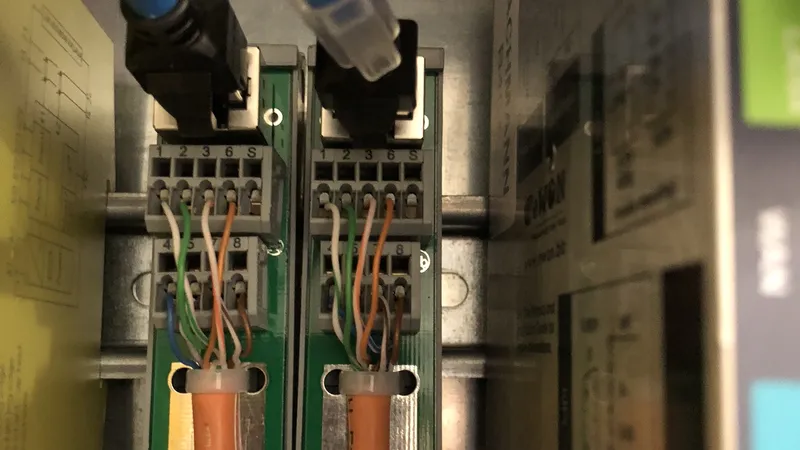
- Cables neatly routed in cable ducts, never loose inside the panel
- Colour coding per EN 60204-1: PE = green-yellow, N = light blue, control voltage = black
- Adequate bending radii, especially for shielded cables
- Ferrules on all flexible conductors
Safety circuits
- Emergency stop circuits wired as normally closed (NC) contacts
- Safety relays category 3 or 4 per EN 13849-1
- Safe separation between power and control circuits
Documentation
- Complete circuit diagram with terminal plan
- Component identification per DIN EN 81346
- Test protocol with insulation resistance measurement
Common mistakes — and how to avoid them
From our 20 years of experience in the food industry, we know the most frequent problems:
1. Wrong protection class: An IP54 panel in a wet area — after the first cleaning day, there is water inside the panel. Always check the actual cleaning conditions on site.
2. Heat dissipation underestimated: Variable frequency drives, power supplies, and PLCs generate heat. Without adequate cooling (filter fans, panel air conditioning), overheating and component failure are inevitable. Rule of thumb: calculate the heat loss and size cooling with 30% reserve.
3. Cable glands not sealed: The best protection class is useless if cable glands are not properly tightened. Use EMC cable glands and check tightness after every maintenance.
4. Missing labelling: In an emergency, every technician must immediately identify which switch controls which function. Clear, permanent labelling of all components is mandatory — not optional.
5. No maintenance access: Panels squeezed behind machine parts delay every repair. Plan at least 800 mm clearance in front of the panel.
Our approach in Switzerland
At VLD Service, we build and wire electrical panels directly on site in Swiss food plants:
- On-site survey: We analyse actual environmental conditions before specifying the panel
- EU-compliant wiring: All panels according to EN 60204-1, with complete documentation
- Fast response: When problems occur, we are on site within 4 hours — throughout German-speaking Switzerland and Ticino
- Existing installations: We also modernise existing panels, such as when retrofitting new VFDs or adding safety circuits
Conclusion
Electrical panel construction in the food industry requires expertise that goes beyond pure electrical engineering. Hygiene requirements, cleaning procedures, and specific environmental conditions must be considered from the very beginning. Cutting corners here — on materials, protection class, or design — costs far more later in repairs and downtime.
Planning a new electrical panel or looking to modernise an existing one? Contact us for an on-site assessment: +41 32 552 28 88 or info@vldservice.ch.
For machinery manufacturers: If you sell machines into Switzerland and need a local installation and service partner, subcontracting or full Swiss service partnership.