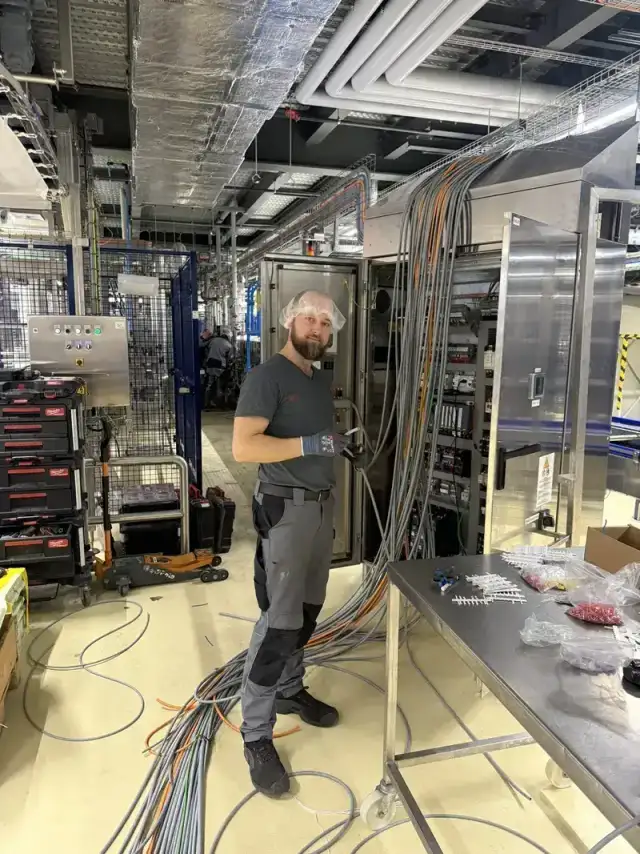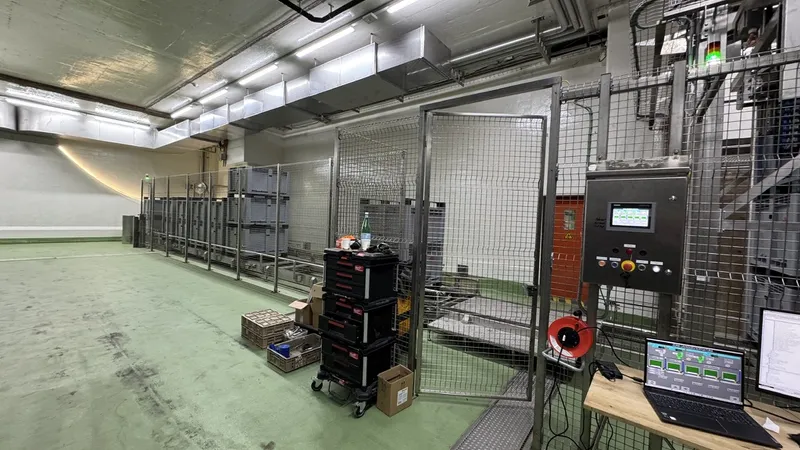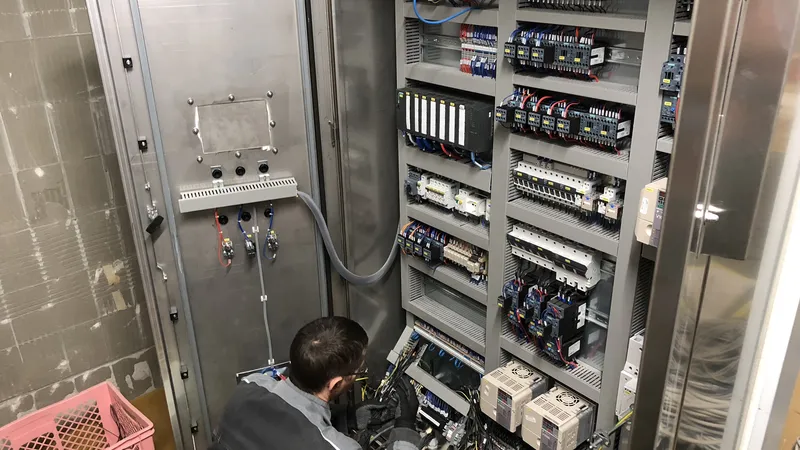
Industrial washing systems in the food industry are highly complex. A modern crate washer in a meat processing plant washes 500 to 2,500 crates per hour — fully automated, with hot water, detergent, and final rinsing. Behind this seemingly simple process lies demanding PLC programming that coordinates dozens of drives, sensors, and control loops.
What a washing system must control
A typical industrial washing system comprises several zones:
Infeed area
- Crate detection: Photoelectric sensors or inductive sensors detect incoming crates
- Cycle timing: The PLC controls the infeed rate for even spacing
- Queue management: At full capacity, the infeed must stop or slow down
Pre-wash
- Temperature control: PID controller for water temperature (typically 40–50°C)
- Pump pressure: VFD-controlled pumps for correct spray pressure
- Dosing: Detergent dosing via solenoid valves and metering pumps
Main wash
- Hot water: 60–85°C depending on requirements
- Detergent concentration: Conductivity measurement for automatic top-up dosing
- Nozzle monitoring: Pressure sensors detecting blocked nozzles
Final rinse
- Fresh water: Last zone with clean water, no detergent
- Temperature: Precise control, as exit temperature affects drying performance
Drying
- Blowers: VFD-controlled fans
- Hot air: Optional, with temperature control
- Energy optimisation: Match drying output to actual demand
Outfeed
- Crate tracking: Each crate tracked through the entire system
- Counting: Piece counter and throughput measurement
- Interface: Handover to downstream conveyor system
PLC architecture
Hardware platform
Two platforms dominate in the Swiss food industry:
Siemens S7-1500 / TIA Portal: The European standard. Broad availability of spare parts and qualified personnel.
Allen-Bradley (Rockwell): Common in plants with US origins. Less prevalent in Switzerland but standard in large corporations.
Software structure
A well-structured washing system PLC uses:
- Main programme: Calling function blocks in logical sequence
- Operating mode management: Automatic, manual, setup, cleaning
- Zone programmes: Each zone as a self-contained function block
- Recipe management: Wash programmes (Normal, Intensive, Eco) as data sets
- Alarm system: Messages with priority, timestamp, and acknowledgement
- Energy management: Record consumption data, avoid peak loads
Recipe management: the heart of the system
| Parameter | Normal | Intensive | Eco |
|---|---|---|---|
| Pre-wash temp. | 45°C | 50°C | 40°C |
| Main wash temp. | 65°C | 80°C | 55°C |
| Detergent conc. | 1.5% | 2.5% | 1.0% |
| Belt speed | 3 m/min | 2 m/min | 4 m/min |
| Drying time | 15s | 20s | 10s |
HMI visualisation
Requirements
- Multilingual: DE/FR/IT as minimum in Switzerland
- Clear: Plant status visible at a glance — active zone, temperatures, throughput
- Alarms: Active faults prominently displayed with clear action instructions
- Trending: Temperature and consumption charts for quality assurance and energy optimisation
- Operator levels: Simple operation for operators, advanced parameters for technicians
Typical challenges
1. Detergent dosing
Too little = insufficient cleaning. Too much = material damage and unnecessary costs. Automatic dosing must be precisely controlled via conductivity measurement.
2. Energy optimisation
Washing systems are major energy consumers. The PLC can achieve significant savings:
- Standby mode during production breaks (maintain temperature, pumps off)
- Control heat recovery from wastewater
- Peak load management: stagger heating phases
3. Integration into the overall plant
The washing system must communicate with upstream and downstream conveyors: cycle synchronisation, empty crate buffer management, data transmission to MES/ERP.
What we offer
Our PLC programmers have experience with washing systems from various manufacturers:
- New programming: Complete PLC software for new washing systems
- Retrofits: Modernise existing controls (e.g. S7-300 → S7-1500)
- HMI development: Multilingual visualisation on WinCC or Ignition
- Remote maintenance: VPN access for fast diagnosis and parameter changes
- Optimisation: Analyse existing programmes to improve energy consumption, cleaning quality, or throughput
Need new automation for your washing system? +41 32 552 28 88 or info@vldservice.ch.
For machinery manufacturers: If you sell machines into Switzerland and need a local installation and service partner, visit our page Install machines in Switzerland — assembly, commissioning and after-sales from one provider.