Aesthetics, discipline, and a way of being in mechatronic service
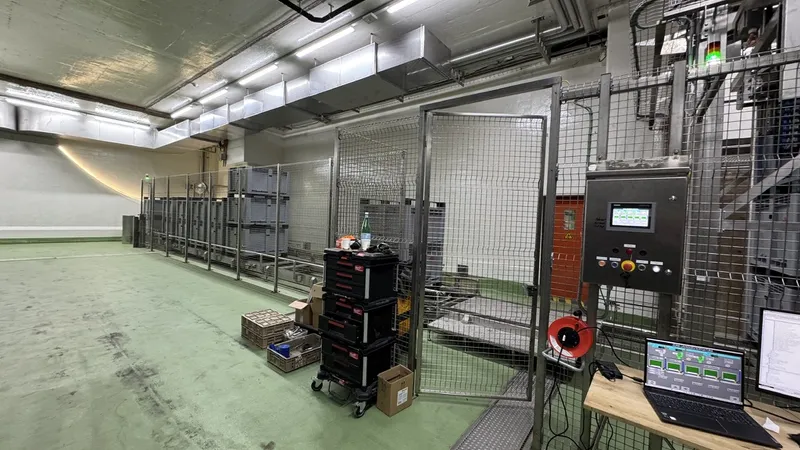
There is a precise feeling that a well-kept plant gives you. You sense it before you see it. The lights hang at the same height, the stainless steel reflects uniformly, the air smells of work, not of neglect. The sounds are the right ones — no anomalous vibrations, no squeaks. You haven’t opened a single panel yet, and you already know that someone has worked here with care.
The opposite holds just as clearly. You feel a disorderly hall within five seconds, even if you couldn’t quite say what tipped you off.
This sensibility is not aesthetics in the decorative sense. It is aesthetics in the ancient sense — what the Greeks called αἴσθησις, the capacity to perceive. It concerns the eye, the ear, the finger that runs along the weld. It is a way of standing before the work.
Two honest relationships with doing
There are two honest ways of relating to work.
For some, work is a business: a transaction, a means to obtain something else. You optimise, you estimate, you close. It is a legitimate choice, made by serious and competent people.
For others, work is a way of being: doing and being are the same. You don’t go to work — you work because that is who you are. The well-wired control cabinet is not a sales argument; it is a silent signature.
Neither is wrong. They are two different existences, both internally consistent. This article speaks about the second, because that is the one we recognise ourselves in.
Four places where discipline becomes visible
In the control cabinet
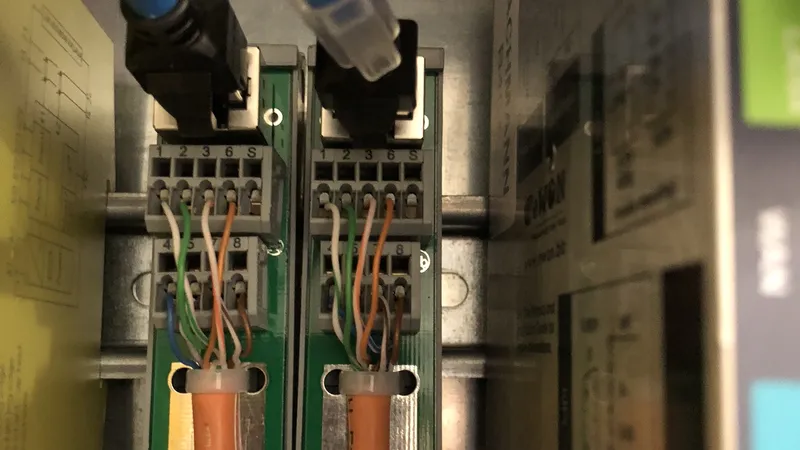
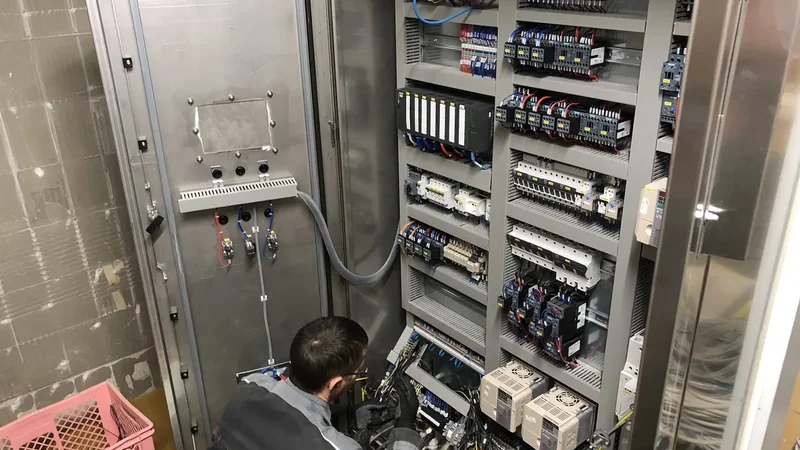
Conductors run parallel, organised by trunking, each labelled. The wire ferrules sit straight because the crimper was well looked after. The terminal blocks follow a scheme another technician can read in two minutes. It is not beauty for its own sake — it is discipline made visible. When the cabinet is opened ten years from now, whoever looks at it will still understand the logic of the person who built it.
In the cable routing
Bend radii are respected, power lines are separated from signal lines, cable ties are pulled to the same spacing. Wiring done in a hurry haunts you for years — interference, internal conductor breaks, ghost faults that are hard to localise. Wiring done properly keeps working after ten years of vibration, washdowns, and thermal cycling. The difference doesn’t show at commissioning. It shows over time.
In the mechanical assemblies
Bolts are torqued, in sequence, in the right direction. Plates are level. Stainless steel welds are uniform, free of spatter, polished where needed. There are no dead spaces where dirt could accumulate — because in the food industry the geometry of an assembly is also hygiene. A poorly conceived joint becomes, months later, an audit finding.
In the alignments
The motor-pump shaft is aligned with a laser, not by eye. Belts have the correct tension, checked with the tool. Bearings are pressed in, not hammered. A rough alignment doesn’t show at first startup — it shows six months later, when the bearing fails. Aligning properly is a gesture of respect toward whoever will next open that machine, and toward the machine itself.
In all four cases the rule is the same: what ends up looking clean was built with discipline. What looks approximate is approximate where you can’t see it too.
An old idea
In many cultures there is a precise figure for someone who works this way.
In Russia he is called мастер — the master for whom good work is honesty toward oneself, before it is honesty toward the client. In Japan it is the shokunin — the craftsman whose identity is inseparable from the craft. In Italy it is the genuine artigiano, who signs his piece because he has put something of himself into it.
Three different cultures, the same idea. Good work is not a commercial strategy. It is a moral position. You do it that way because you wouldn’t know how to do it differently.
The food industry recognises this frequency
In food production, care is not a rule, it is a culture. The stainless steel reflects, the floors are immaculate, the welds are radiused. Everything speaks the same language.
An installation that arrives in this environment with a disorderly cabinet, cabling laid at random, askew assemblies — does not work. Not because it is technically wrong, but because it breaks the grammar of the place. It contradicts what, all around, is the standard.
Conversely, an installation built with the same discipline as the production itself fits in. The operator opens it and understands. The QA manager looks at it and recognises it. The owner, when showing it to a visitor, runs a hand over it without needing to explain anything.
Our way
We work this way because we wouldn’t know how to work differently. Control cabinet, cable routing, mechanical assemblies, alignments — in all four dimensions the level is the same, even where no one will ever look again. It is not a positioning strategy; it is a posture.
We look for clients for whom this matters.
Independent mechatronic service partner for the Swiss food industry. Also installation partner for machinery manufacturers in the DACH region.