Many plants in the Swiss food industry have been running on Siemens controls of the S7-300 or S7-400 generation for fifteen, twenty years or more. The mechanics are solid, the plant concept often better than what would be bought new today. But the control system is reaching end of life: spare parts are getting scarce, the STEP 7 Classic engineering tool is discontinued, safety functions no longer meet current standards. A complete new build would be oversized and expensive. The answer is called control system retrofit.
What a control retrofit actually means
A control retrofit replaces the PLC hardware and migrates the application program to a modern platform: typically from S7-300 to S7-1500 with engineering in TIA Portal. The plant mechanics, drives, sensors, actuators and operator panels normally stay in place or are modernised in a targeted way. Goal: same plant, but ten years of future ahead.
Typical triggers in Swiss food production:
- Phase-out of S7-300/S7-400: Siemens is gradually taking this generation out of its range. Spare parts remain available for some years, but with longer lead times. Which module is discontinued when is stated in Siemens’ product notices; we check this for your plant.
- STEP 7 Classic on the way out: last supported Windows version, no new features. TIA Portal is the future
- Functional safety: older plants often do not meet EN ISO 13849 PL d/e. Every major change requires reassessment
- MES/ERP connectivity: OPC UA, MQTT, REST interfaces are awkward on old CPUs
- Audit requirements: IFS/BRC increasingly ask for documented controls, recipe management, traceability
Migration paths: which CPU class for which plant
TIA Portal supports migration wizards from S7-300 to S7-1500. The target CPU choice depends on plant scope:
S7-1200: For smaller plants up to roughly 30 I/O modules, simple logic, no high determinism required. Typical: washing systems, single conveyors, packaging modules.
S7-1500 (1511/1513): Medium plants. Better performance, more connectivity, integrated web server. Standard for most food plants.
S7-1500F: When functional safety should be part of the control (Safety CPU). Mandatory for protection circuits not solved in hardware. In Swiss food plants often desired because it simplifies wiring and maintenance.
S7-1500T: For plants with motion control (synchronised axes, cam control). Relevant for packaging lines, robotics, high-speed machines.
We make the decision together with the plant manager after a site survey.
Approach: from survey to commissioning
1. Site survey (1–2 days)
On site: catalogue all CPUs, I/O cards, drives, HMIs. Extract and back up existing software. Talk with plant operations: which functions hurt today, what would be desired for tomorrow? The survey is the basis for a serious cost estimate.
2. Software migration
In TIA Portal: import the STEP 7 Classic project, run the automatic conversion, then manual rework. Empirical value: 60–80 % of code converts cleanly, 20–40 % needs adjustment. Frequent points:
- Addressing: optimised blocks in TIA Portal use symbolic addressing: existing code with absolute addresses needs rework
- HMI screens: WinCC flexible / Classic must be migrated to WinCC Comfort/Advanced
- Libraries: old libraries (e.g. Modicon drivers, OEM-specific FBs) must be replaced or reprogrammed
3. Functional safety reassessment
On every retrofit we review safety functions against EN ISO 13849. Often the old plant works but the required Performance Level (PL d or e) is not documented. The retrofit is the natural moment to put that right.
4. Factory Acceptance Test (FAT)
Before the plant is shut down, we test the new control in the workshop as far as possible. Simulations, hardware-in-the-loop, dry runs. This saves hours on site later.
5. Conversion on the plant
Here every minute counts. Typical weekend shutdown sequence:
- Friday evening: production winds down, cleaning
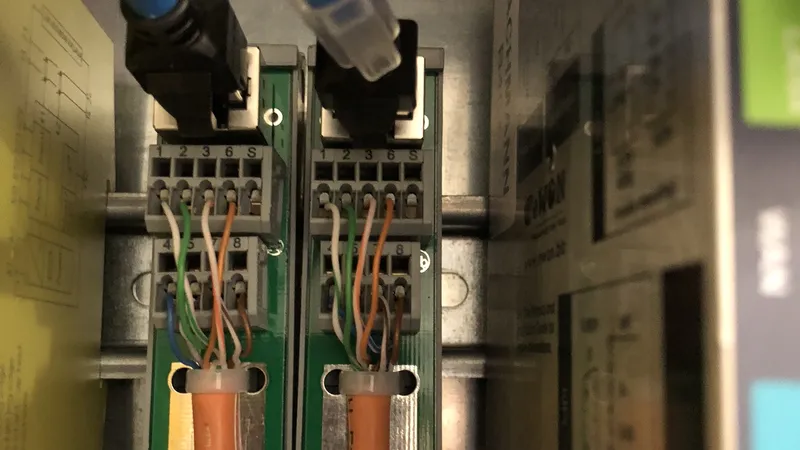
- Saturday morning: dismount old CPU and I/O cards, install new hardware, check wiring
- Saturday afternoon: load CPU, I/O check, first functional tests
- Sunday: trial run with product-water / cleaning cycle, fine-tuning
- Sunday evening / Monday morning: production restart
For larger plants we spread the work over two weekends with intermediate operation.
6. Hypercare (1–2 weeks)
After restart: technician on standby, fast response to unexpected behaviour. This is where edge cases not covered by the FAT show up.
Typical risks and how to mitigate them
Risk: commissioning runs late. The weekend shutdown is not enough, production is down on Monday. Mitigation: clean FAT, time buffers planned, clear fallback scenario to old control (old hardware not scrapped immediately).
Risk: HMI panels no longer work properly. WinCC migration often brings subtle changes: trends, recipes, permissions behave differently. Mitigation: involve operating staff early, let them practise on a test HMI in parallel.
Risk: drives are not commanded correctly. Migrating Profibus-DP drives to Profinet is extra work. Often more practical: keep Profibus via CM modules on the S7-1500. Mitigation: decide at survey time what to migrate and what to keep.
Risk: food-specific requirements underestimated. Hygiene, CIP control, recipe management, batch traceability: a generic industrial builder often misses these. Mitigation: choose a retrofit partner with sector experience.
Cost drivers: what moves the price
We do not publish rate cards, but the factors are transparent:
- Number of I/O and complexity of mechanics: more cards, more wiring work
- Quality of existing documentation: is the logic diagram up to date? Are P&IDs available? Poor documentation doubles engineering hours
- Functional safety: Safety CPU + certified safety circuits raise the effort but save wiring
- Shutdown window: one weekend is cheaper than two, but riskier
- HMI migration: if a new panel generation is adopted in parallel (WinCC Unified, Industrial Edge), additional effort
A serious quotation always starts with a survey. It usually appears as its own small line item on the invoice, and it carries the whole cost estimate: without it, every figure is guesswork.
When retrofit, when new plant
Rule of thumb: if mechanics are healthy, plant capacity covers today’s demand, and only the control is at end of life: retrofit. If mechanics are worn, the line too slow for today’s volumes, or the layout must change fundamentally: consider a new plant.
In the Swiss food industry, retrofit is often the economically sensible choice: solid stainless-steel mechanics age slowly, the control system is the fast-ageing part.
How we work
VLD Service plans and executes control retrofits in the Swiss food industry, from site survey, through migration into TIA Portal, to weekend commissioning. We work with Siemens S7-1200, S7-1500 and S7-1500F, program in the IEC languages, integrate WinCC HMI and connect plants to higher-level systems via OPC UA.
We come on request for a no-obligation site survey. The result is a concrete approach matched to your plant: not a generic catalogue quotation.
Independent mechatronic service partner for the Swiss food industry. Also installation partner for machinery manufacturers in the DACH region.