It’s Tuesday morning at 6:15 a.m. The early shift has just started, the meat processing line is running at full capacity — and suddenly the conveyor belt stops. No alarm, no error code, just standstill. The production manager is standing in front of the line and knows: every minute counts now.
This scenario is not an isolated case. In the food industry, unplanned machine failures are among the most expensive operational disruptions of all — not just because of lost production time, but also because of perishable goods, interrupted cold chains and endangered delivery deadlines.
What Production Downtime Really Costs
The direct costs of a machine failure in food production are often underestimated. Depending on the size of the operation and the system, downtime costs range between CHF 5,000 and 50,000 per hour — sometimes significantly more. This figure is made up of:
Lost production: Every hour of downtime means products that are not manufactured. For contract production for retail, this can lead to direct contractual penalties.
Perishable goods: In meat processing, dairy or convenience food, the biological clock keeps ticking even when the machine is stopped. Raw materials in the processing chain can become unusable if the cold chain is interrupted or processing deadlines are exceeded.
Personnel costs: Your employees are standing by but cannot produce. With shift operations, this adds up quickly.
Consequential damage: A stoppage at one point in the line can trigger chain reactions — congestion before the defective machine, idle time after it, right through to a complete production shutdown.
Reputational damage: Repeated delivery delays jeopardise business relationships with your customers. In Swiss retail, the demands for reliability are particularly high.
The First 30 Minutes: Responding Correctly
The way you respond in the first minutes after a machine failure often determines whether the downtime lasts hours or days. Here is a proven procedure:
1. Assess the Situation
Before you do anything: what exactly happened? Which machine is affected? Is there an error code? Did anyone notice anything unusual (noise, smell, vibration)? Is there obvious mechanical damage? This information is crucial for a rapid diagnosis — whether by your own team or by external specialists.
2. Check Safety
Is there a danger to people? Leaking fluids, exposed cables, unstable machine parts? Safety always comes before production.
3. Initiate Damage Limitation
Can the product in the system be saved? Do raw materials need to be refrigerated or relocated? Can the line continue to operate partially by bypassing the defective station?
4. Start Diagnosis
Does your internal team have the expertise to analyse the problem? With mechanical defects (broken shaft, defective drive), the cause is often quickly identifiable. With electrical or control problems (PLC errors, intermittent failures, communication problems), troubleshooting can be significantly more complex.
5. Call for External Help — Early
This is where many companies make a mistake: they wait too long before calling external specialists. The thought “maybe we’ll find it ourselves” often costs hours during which production is at a standstill. If your team doesn’t have a clear diagnosis after 30 to 60 minutes, it’s time to get professional help.
Common Causes of Machine Failures in the Food Industry
From our experience with hundreds of emergency callouts in the Swiss food industry, we see the same causes time and again:
Mechanical Causes
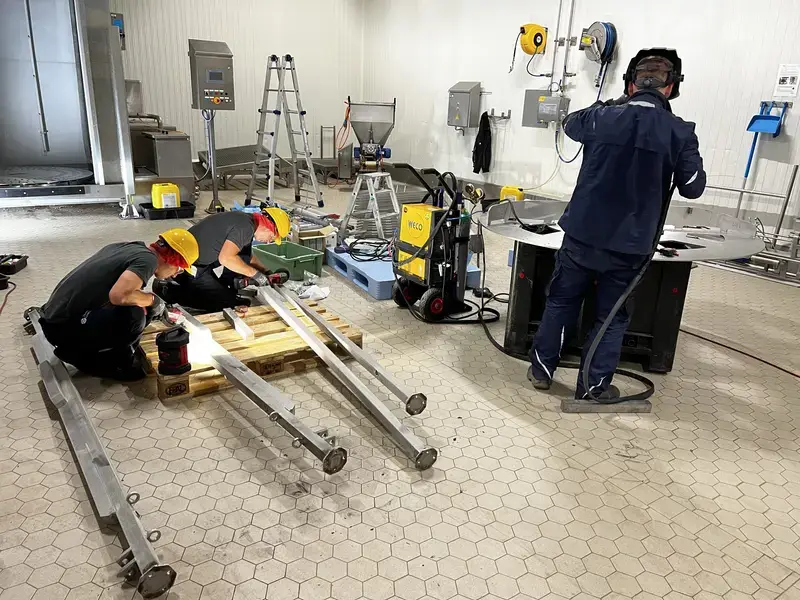
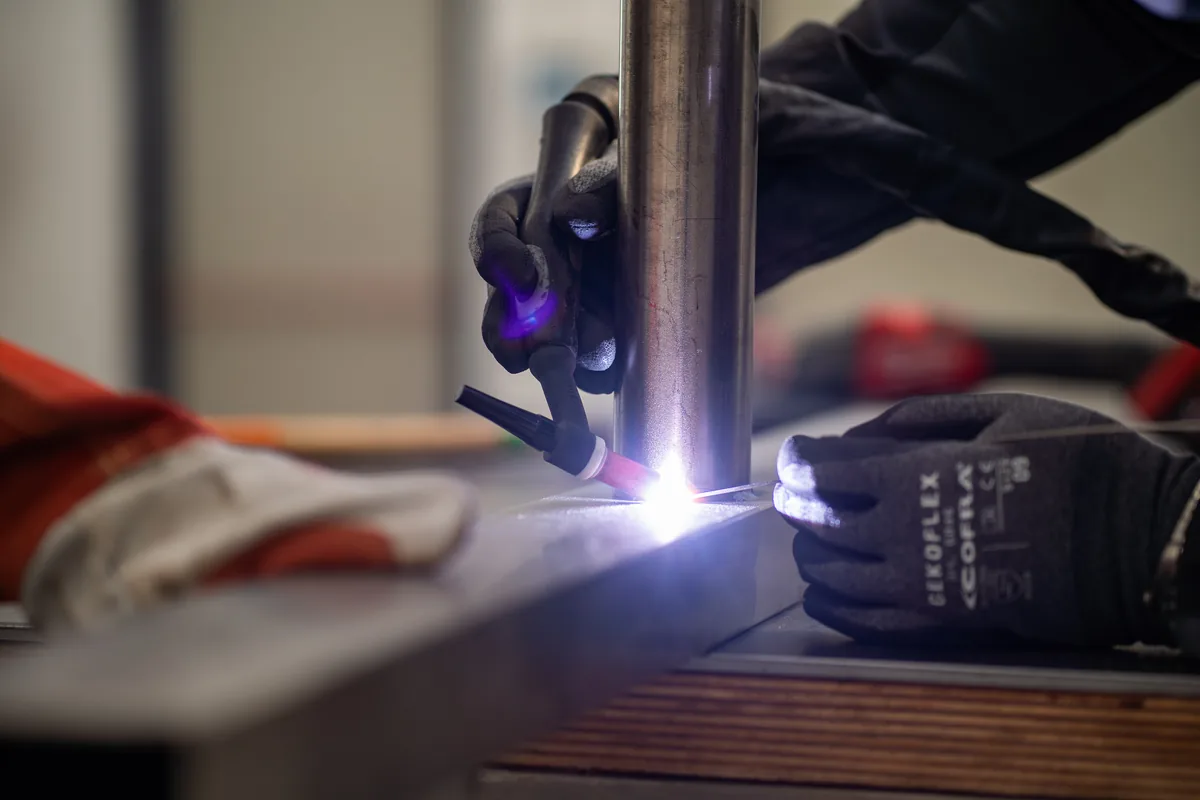
Worn conveyor belts and rollers, defective geared motors, broken shafts, leaking seals and pipes, loosened fastenings. In the food industry, there is an additional factor: corrosion from aggressive cleaning agents and moisture, even on stainless steel, if the alloy or the weld is not optimal.
Electrical Causes
Defective frequency inverters, blown fuses, oxidised contacts, cable breaks (especially at points with movement or moisture), defective sensors and proximity switches. In the wet production environments typical of the food industry, electrical problems are particularly common.
Control System Causes
PLC program errors after updates, defective communication between machine components, failed bus systems, incorrect parameterisation. Particularly tricky: intermittent faults that only occur under certain conditions and are difficult to reproduce.
Pneumatic Causes
Pressure losses, defective valves, dirty filters, leaking hoses, defective cylinders. Pneumatic problems often manifest as “the machine doesn’t do what it’s supposed to anymore” — slow movements, inaccurate positioning, unreliable clamping.
How to Prevent Downtime in the Future
The best emergency callout is the one that isn’t needed. These measures significantly reduce the risk of unplanned failures:
Regular inspection: Once a year, an experienced technician should systematically go through your system: check wear parts, inspect connections, examine the electrical cabinet, test safety devices.
Replace wear parts in time: Conveyor belts, rollers, seals, bearings, coupling elements — these parts have a limited lifespan. Replace them preventively before they fail. This costs a fraction of an emergency repair.
Keep documentation up to date: Wiring diagrams, PLC programs, spare parts lists — if these documents are missing or outdated, every fault search takes significantly longer.
Stock spare parts: Keep critical spare parts in stock: geared motors, frequency inverters, proximity switches, fuses. A spare part worth CHF 500 in stock is better than CHF 20,000 in lost production while the part is ordered.
Know an external partner: When the emergency strikes, it’s too late to search for a service provider. Already have contact with an experienced service partner who knows your industry and is quickly available.
When You Need External Help
Not every machine failure requires external specialists. But in these situations, professional help is almost always the better choice:
- Your internal team doesn’t have a clear diagnosis after one hour
- The fault concerns the PLC or complex automation
- Stainless steel welding work is required
- The OEM manufacturer is not available at short notice or is too expensive
- You need someone who masters mechanics, electrics and control systems simultaneously
- The repair must be carried out in compliance with HACCP
In these cases, a specialised service partner saves not only time but also money — because the diagnosis is faster and the repair is done right the first time.
Conclusion
An unplanned production stoppage is stressful and expensive. But with the right response in the first minutes, a clear escalation strategy and the right preventive maintenance, the damage can be significantly limited — and the frequency of such incidents considerably reduced.
If you are looking for a reliable partner for emergency callouts and preventive maintenance in the food industry: VLD Service is at your service throughout Switzerland — fast, competent and manufacturer-independent.